In continuation of my first article on the Mongol-Tatar yoke , I would like to dwell on one more question that appeared in my head back in my school years:
what happened to human civilization after the fall of the Roman Empire?
Reading the myths of Ancient Greece, the poems of Homer, the tragedies of Sophocles and Euripides, enjoying the amazing frescoes and sculptures, we admired the culture and art of the ancient world. Then came the Roman civilization. Architecture, poetry, painting and sculpture were striking in their perfection. And suddenly … The Roman Empire, under the onslaught of the barbarians, staggered and collapsed. And the entire civilized world plunged into the darkness of the Middle Ages for more than a thousand years. Humanity has degraded! And, most importantly, no special events happened. The empire of the Franks, Charlemagne, the Habsburgs – everything is very incomprehensible, events are little connected with each other. In general, before the beginning of the Renaissance – the Renaissance, nothing interesting and meaningful happened. This is over a thousand years. Art and sciences have disappeared .. From this time I have a very vague feeling of gloomy medieval castles.And that’s it! The Crusades, Hamlet’s “to be or not to be” and the blazing fires of the Inquisition – this is much later – this is another millennium. The feeling that everyone wants to forget about these thousand years, and they write about them with great reluctance, everything is too tense, or there are few sources, or maybe they simply did not exist? … Why is there so much about the Ancient World?
Historians, it turns out, are also racking their brains over the still unsolvable question for them – why so few medieval monuments of material culture and so many antiquities have survived to this day ? It would be more logical, it would be the other way around.
“… They explain this by the fact that after a centuries-old period of rapid development, ancient civilizations suddenly degraded and fell into decay, having forgotten all the scientific and cultural achievements of antiquity. And only in the 15-16th centuries, in the era of “Renaissance”, people suddenly remembered all the discoveries and achievements of their civilized “antique” ancestors and, from that moment, began to develop dynamically and purposefully. “
Not very convincing!
According to the creators of “New Chronology”, during the rebellion, known to us as the “Reformation”, in the XVI century AD. virtually all of world history was rewritten and rewritten up to the 19th century. And, of course, CHRONOLOGY. The reason is usual. When the central power begins to weaken, the provinces of the empire seek to get out of subordination and gain independence, as we see in the example of very recent events. The governors, the kings of the European provinces of the empire regularly paid tribute to the central government and obeyed the Tsar of Russia-Horde, that is, the Emperor. But in the middle of the XVI century. they refused to obey the center. The ideological banner of this revolt was Lutheranism, as a pretext for political separation from the empire. First, the rebellion swept the whole of Western Europe, and then came to Russia. As a result, the Great Troubles and the change of dynasties.The Romanovs reigned on the Russian throne, replacing the Rurikovichs, and Europe plunged into the long decades of bloody wars of the Reformation for dividing the heritage of the empire. Both the new rulers in Europe and the Romanovs in Russia were forced to rewrite history in order to justify their right to power and the antiquity of the family. The Great Mongol Empire was erased from the pages of history. Many important events have been pushed back into antiquity. Here is how the author of the recently released film “Non-existent Millennium”, Yuri Elkhov, writes about it:Many important events have been pushed back into antiquity. Here is how the author of the recently released film “Non-existent Millennium”, Yuri Elkhov, writes about it:Many important events have been pushed back into antiquity. Here is how the author of the recently released film “Non-existent Millennium”, Yuri Elkhov, writes about it:
“… The chronology of ancient and medieval history in the form in which it exists today was created only in the XVI-XVII centuries AD by the Western European chronologist JOSEPH SCALIGER and the Catholic Jesuit monk DIONYSUS PETAVIUS. However, their dating methods, like those of their predecessors, were imperfect, erroneous and subjective. And, more often, these “mistakes” were of a deliberate (ordered) nature. As a result, the story was extended by a thousand years , and this extra millennium was filled with phantom events and characters that never really existed before.
Now we go further: the dates in the Middle Ages according to the “JULIAN” and “GRIGORIAN” calendars, leading chronology from the “CHRIST’S BIRTHDAY”, were written in letters and numbers.
X = “Christ”
The Greek letter “X”, before the date written in Roman numerals, once meant the name “Christ”, but was later changed into the number 10.
Thus, there was a chronological shift of medieval dates by 1000 years, when later historians compared two different ways of recording. The first method was to write down completely –
“I century from the birth of Christ”
“II century from the birth of Christ”
“III century from the birth of Christ”
The second way was the abbreviated notation. Dates were written like this:
X. I = from Christ 1st century
X. II = from Christ II century
X. III = from Christ III century
etc.
where “X” is not the Roman numeral 10, but the first letter in the Greek word for “Christ”.
When the date was written in Arabic numerals, the letter “I” was put in front of them – the first letter of the name “Jesus” written in Greek and separated by a dot. But later, this letter was declared a “unit”, supposedly meaning “one thousand”.
I.400 = “from Jesus the 400th year”
Therefore, the record of the date I.400, for example, originally meant: “From Jesus the 400th year.”
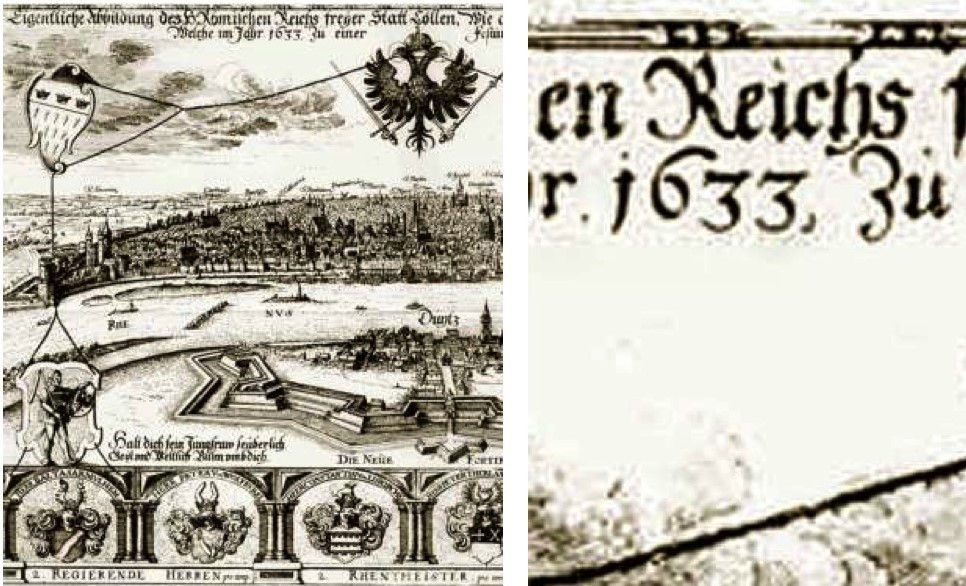
The old plan of the German city of Cologne is dated, which modern historians read as 1633. However, here the Latin letter “I” with a dot is completely different from a unit. This means that the correct dating of this engraving is 633 from the “Nativity of Christ”.
By the way, here too, we see an image of a two-headed eagle, which once again testifies that Germany was once part of the Russian Empire.
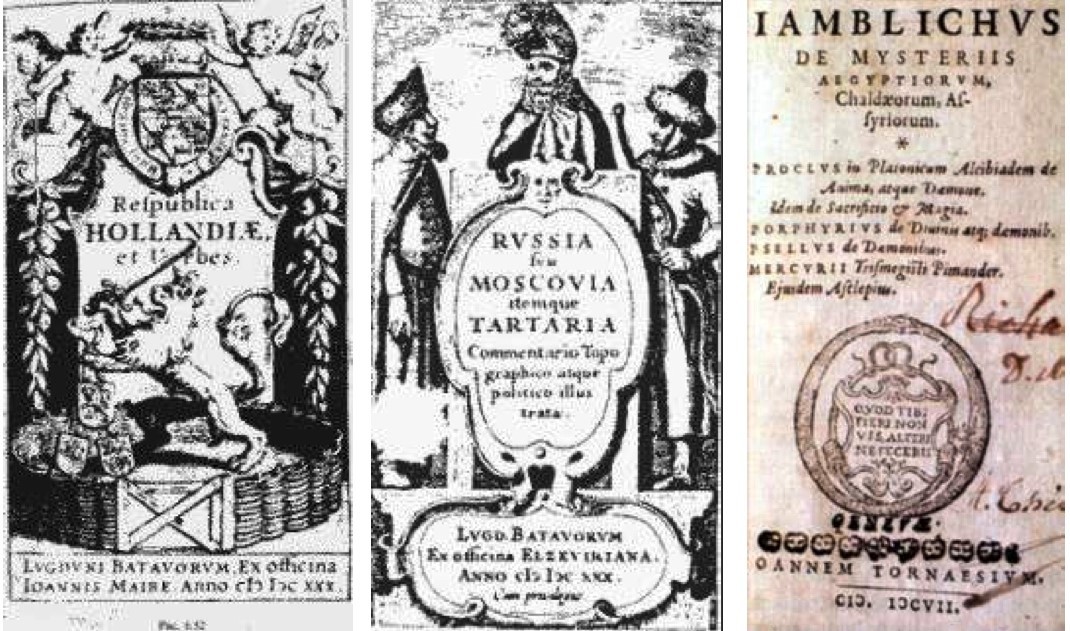
And here is another entry using right and left crescents, separating the Latin letter “I” from Roman numerals, as the dates are written on the title pages of these books. The name of one of them: “Russia or Muscovy, called TARTARIA”.
Of course, today it is quite difficult for a common man to believe in this, especially in adulthood. The load of knowledge gained throughout life does not give him the opportunity to break free from the shackles of habitual, externally imposed, stereotyped beliefs.
Historians, whose doctoral dissertations and other fundamental scientific works were based on virtual Scaligerian history, categorically reject the idea of a “NEW CHRONOLOGY” today, calling it “pseudoscience”.
And instead of defending their point of view in the course of a polemical scientific discussion, as is customary in the civilized world, they, defending the honor of their “official uniform”, are waging a fierce struggle with supporters of the “NEW CHRONOLOGY”, as in the days of medieval obscurantism, guided by her only one common argument: “This cannot be, because this can never be!”
Yes, it’s probably hard to believe right away. At the first encounter with the “NEW CHRONOLOGY” project, I also experienced a shock. But having studied some materials more carefully, I began to trust these scientists more and more. Even just looking at the amount of work and material that needed to be studied, I begin to think that after all, this is a scientific feat. And most likely future generations will appreciate this gigantic work.
After all, until quite recently, in the Middle Ages, no one believed that the EARTH TURNS!
Author: Anatoly Panikov

 Tartaria Empire Youtube