CNN — They’re scattered all over Europe but their perfect geometrical beauty can only be fully admired when seen from above.
Like snowflakes viewed through a magnifying glass, there’s a dazzling fractal-like quality to the neat, intricate way they’ve been laid out – just that we’re not talking here about natural wonders.
An entirely new, rational way to design fortified settlements, the “star cities” of the 16th and 17th centuries were a jewel of the early modern era and engineered by some of the most brilliant minds of their time.
The science of building star-shaped bastion forts came into being in Italy during the Renaissance, when gunpowder and cannon rendered old medieval walls obsolete.
High, vertical walls gave way to low-lying ramparts, which offered less of a target, while wide moats, sloping earthworks and complex networks of protruding bastions would eliminate any blind spots and prevent besieging armies from coming anywhere near the ramparts.
Related article Llivia: The Spanish town stranded in France
This style of military architecture would have its golden era during the 1500s and particularly the 1600s, a period in which many parts of Europe saw almost uninterrupted warfare.
It’s not a coincidence that some of its best and most magnificent examples cluster in places such as the Netherlands and the Rhine Valley, fault lines between warring empires.
Military engineers such as the Frenchman Sébastien Le Prestre de Vauban and his Dutch rival Menno van Coehoorn elevated the fortification of cities almost to the category of art.
Successive changes in military technology rendered many of their “star cities” obsolete, but since many of them had by then become civilian settlements, this eye-catching approach to urban planning was not lost to time.
What follows is a selection of some of Europe’s most beautiful star cities. While the list of star-shaped forts in Europe is much longer, we have deliberately focused on those that became home to living communities, all while preserving the original geometrical layout.
The Netherlands
Naarden
The Netherlands is a prime destination for those interested in “star city” architecture. The Dutch Revolt (1566-1648) is the name given to the long years of war that followed the Dutch rebellion against Spanish rule and it left its mark on the urban landscape of a land otherwise devoid of natural fortifications.
Perhaps the most impressive of the Dutch star cities is Naarden, some 20 kilometers east of Amsterdam. Entirely surrounded by two lines of fortification and two rings of water, Naarden might just be the perfect star-shaped city. It is also, very fittingly, the site of the Dutch fortress museum.
Brielle
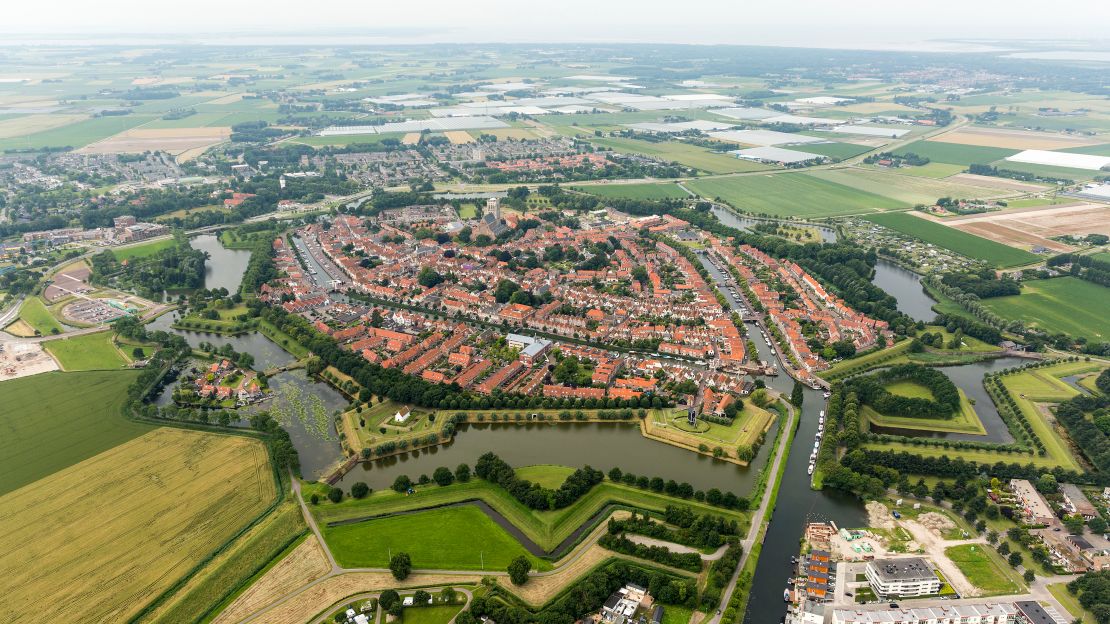
Brielle is a seaport once seized by the Watergeuzen (or “Sea Beggars”). Shutterstock
The city of Brielle has a place of honor in Dutch history since 1572 when its capture by the “Sea Beggars,” a seafaring nationalist militia, marked a major turning point in the Dutch war of independence.
Although now dwarfed by the docks of neighboring Rotterdam Europoort, Europe’s largest commercial port, its neatly laid out bastions and moat are easy to spot from the sky.
Heusden
Completed in 1597, Heusden can boast today of its impressive, neatly arranged bastions thanks to an award-winning, 40-year-long reconstruction project.
By the 19th century, this North Brabant town’s original fortifications had all but crumbled away. However, starting in the 1960s, local residents led a successful campaign to restore Heusden to its former glory. A 300-year-old map was used as a blueprint to turn the place into a beautiful period town that pre-pandemic was getting hundreds of thousands of visitors every year.
Willemstad
Also in the region of North Brabant, this small town is another prime example of a Dutch star city.
It’s said that each of its seven bastions represents one of the seven provinces that united to liberate the Netherlands from Spanish rule in the 16th century, forming an independent Dutch state.
Bourtange
In the northeast Netherlands, just yards from the German border, Fort Bourtange was built in 1593 and used until 1851.
The fortress was then turned into a village, preserving its perfectly pentagonal shape and geometrical street pattern, but it never really prospered as a civilian settlement. Today, the whole architectural ensemble is open to visitors as a museum.
Italy
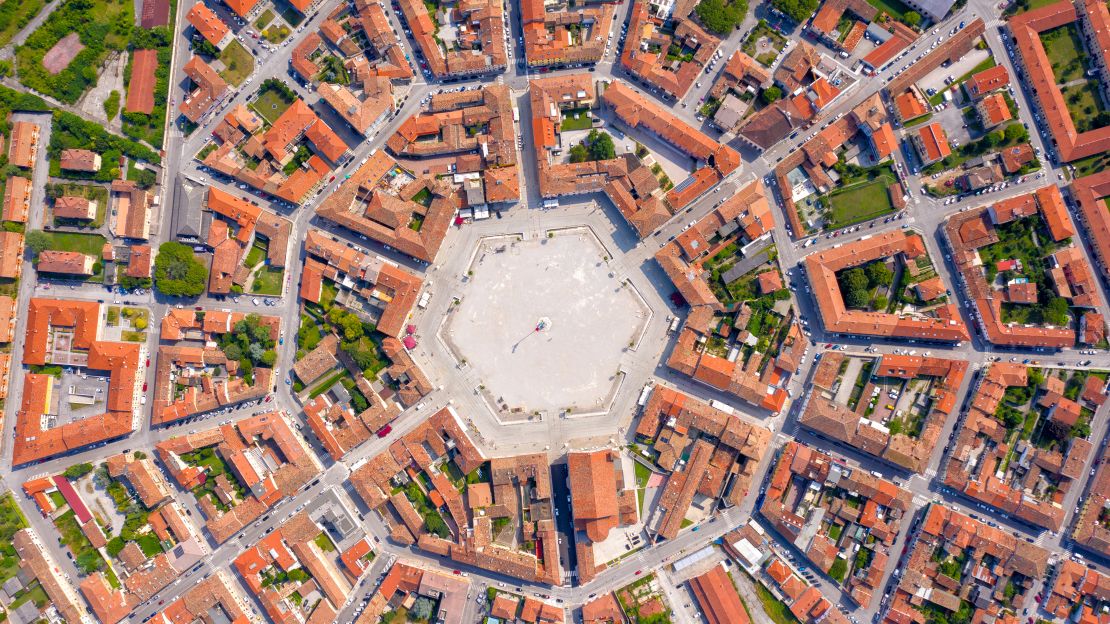
Palmanova was founded in 1593. Shutterstock
Palmanova
Located very close to the present-day border between Italy and Slovenia, Palmanova (not to be mistaken for the Majorcan resort of the same name) is the quintessential geometrical city as well as one of the largest and best preserved. The Venetians built it in the late 16th century in order to defend the northeastern border of their Most Serene Republic.
Its radial layout expands from a central hexagonal square (the “Piazza del Duomo”) in concentric nine-sided rings traversed by straight avenues leading to each of its angles. The whole ensemble is encircled by an outer double perimeter of star-shaped fortifications.
Palmanova has been designated a World Heritage site by UNESCO (together with other Venetian fortifications of the same era).
Peschiera del Garda
If Palmanova protected the eastern approaches to Venice, its western ones were under the watch of Peschiera del Garda, which also has World Heritage Site status. Quite appropriately for a place that was long ruled by Venetians, the fortified city is not so much on the shores of Lake Garda, but inside of it, surrounded by water on all its sides, with a canal cutting right through it.

 Tartaria Empire Youtube